


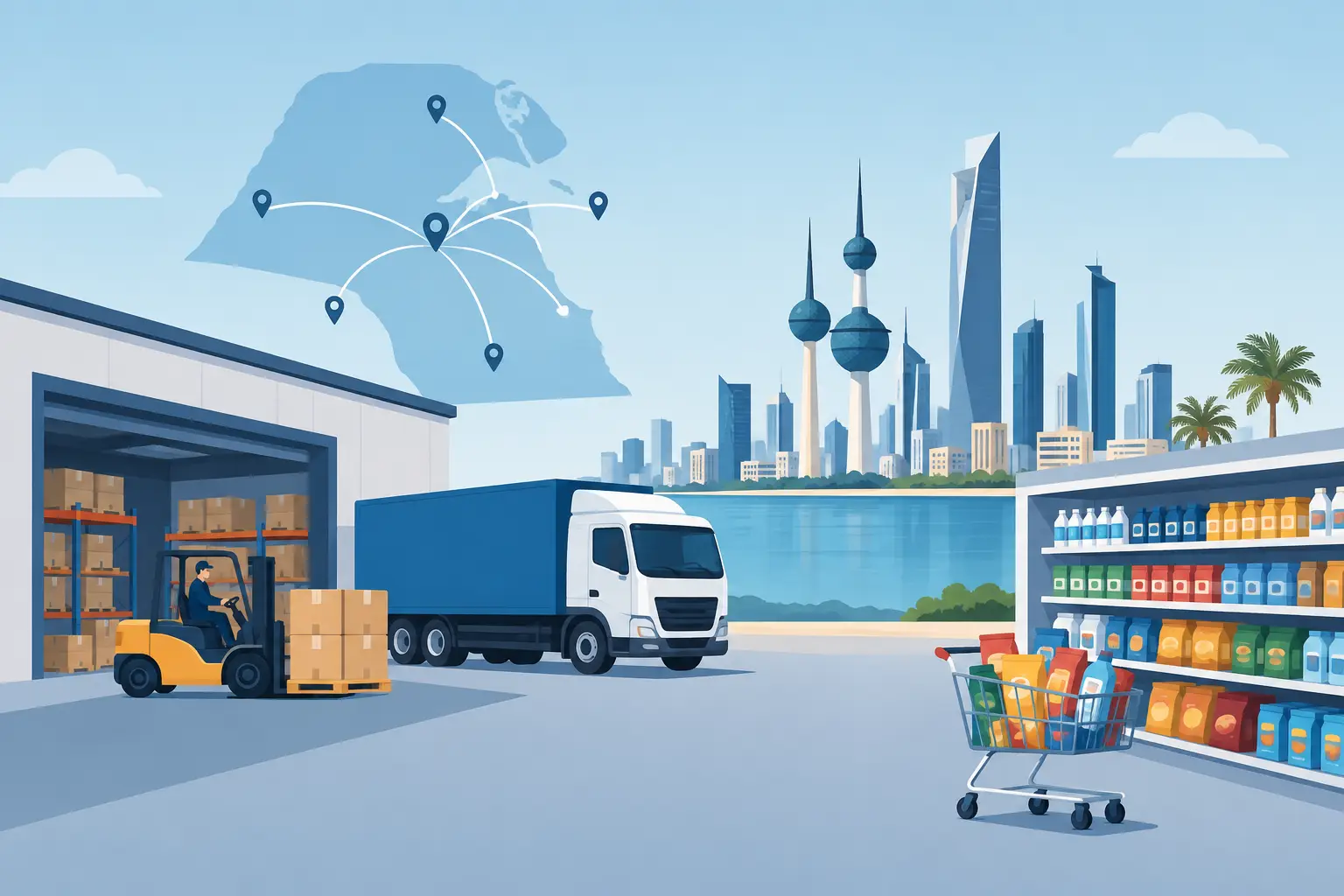
FMCG Distribution Network Case Study in Kuwait
A fast-moving consumer goods operation can lose retailer confidence long before it loses a major account. A missed delivery of bottled water, snacks, personal care products, or cleaning supplies may look minor in isolation. Repeated across dozens of stores, it creates empty shelf space, rushed replenishment orders, excess transport cost, and inaccurate demand signals. This FMCG distribution network case study examines how a Kuwait-based distributor can restore control by redesigning the flow from inbound freight through warehouse fulfillment and last-mile store delivery.
The scenario is representative of a growing FMCG business supplying supermarkets, co-ops, convenience stores, pharmacies, and food service customers across Kuwait. It is not about adding complexity for its own sake. It is about creating a distribution model that protects availability while keeping inventory, transport, and labor costs within control.
The Operating Problem
The distributor handled a mixed portfolio of imported and locally sourced products. Containers arrived through sea freight, selected urgent items came by air freight, and local suppliers delivered directly to the warehouse. The business had grown quickly, but its distribution process had not kept pace.
Inventory was held in one central facility, and store orders were released throughout the day. Delivery routes were planned manually after orders had already been picked. High-volume customers received frequent deliveries, but schedules changed constantly. Smaller stores were often served late, despite having limited backroom space and a high dependence on regular replenishment.
Three issues were creating pressure. First, fast-selling stock was available in the warehouse but not consistently available at the store level. Second, transport costs rose because vehicles left with incomplete loads or made unplanned repeat trips. Third, teams lacked a single operational view of inbound cargo, warehouse stock, orders in process, and delivery status.
The result was a familiar FMCG problem: inventory existed, but service reliability did not.
FMCG Distribution Network Case Study: The Redesign
The distributor did not need a larger network immediately. It needed clearer rules for how products moved through the network. The redesign centered on a controlled central warehouse, defined delivery zones, customer service schedules, and shipment visibility from port to proof of delivery.
1. Segmenting Products by Demand and Handling Need
The first change was product segmentation. The company stopped treating every stock keeping unit the same way.
High-volume, predictable products such as water, tissue, detergent, and core grocery lines were stored in easily accessible pick locations near dispatch. These products were replenished frequently from reserve storage and planned around full-case or pallet quantities where possible.
Lower-volume and promotional items were held in separate locations. This reduced congestion in the primary picking area and prevented slow-moving products from consuming the most valuable warehouse space. Fragile, temperature-sensitive, regulated, or high-value items required their own handling rules, not a one-size-fits-all process.
This distinction matters because the right inventory position depends on product velocity. A central warehouse is often efficient in Kuwait because distances are manageable, but a fast-moving line can still fail if its pick face is empty during the morning delivery wave.
2. Setting Service Windows by Customer Type
The next decision was to replace ad hoc delivery requests with service windows. Large supermarkets and co-ops were assigned scheduled delivery days and cutoff times based on volume, receiving capacity, and sales patterns. Convenience stores and pharmacies were grouped into repeatable route clusters. Food service customers with tighter operating hours were handled through dedicated delivery slots.
This did not mean the distributor stopped supporting urgent orders. It meant exceptions became visible and measurable rather than becoming the normal operating method.
For example, a high-volume retailer might receive three planned deliveries per week, with an agreed next-day order cutoff. A smaller convenience channel could receive two fixed replenishment runs weekly, with additional deliveries reserved for genuine stock risk. The delivery promise became more dependable because warehouse picking, vehicle allocation, and customer receiving teams worked from the same schedule.
3. Building Delivery Zones Around Route Density
Instead of assigning deliveries based only on order timing, the operation divided Kuwait into practical delivery zones. Routes were built around geographic density, vehicle capacity, delivery time requirements, and the number of stops a driver could complete without creating delays.
This improved load utilization. A truck carrying orders for nearby customers could leave with a fuller load and complete a planned sequence of deliveries. It also reduced the number of empty or partially loaded return movements.
There is a trade-off. Fixed routes can feel less flexible to sales teams that want every customer request delivered immediately. However, a network built entirely around urgent delivery requests usually raises cost and reduces reliability for everyone. The better approach is to establish clear standard service levels, then reserve expedited transport capacity for high-priority cases.
4. Connecting Inbound Freight to Inventory Availability
The distributor also addressed a less visible cause of stockouts: unreliable inbound planning. Purchase orders were often based on historical sales, but the warehouse team did not always receive timely information about vessel arrivals, customs clearance progress, or delivery appointments from the port.
The revised process required inbound freight milestones to be shared with procurement and warehouse teams. Before a container arrived, the warehouse received the expected pallet count, SKU profile, handling requirements, and delivery date. Customs documentation was reviewed early to reduce avoidable clearance delays.
Once freight was released, receiving appointments were scheduled around warehouse labor and available put-away capacity. Priority products moved through receiving and quality checks quickly, while slower-moving lines could be processed in a less urgent window. This reduced the time between cargo arrival and sellable inventory.
For an importer, this connection is critical. Inventory planning is not only a purchasing function. It depends on freight forwarding, customs clearance, receiving discipline, and accurate stock records.
What Changed in Daily Operations
Within the redesigned model, the warehouse began each day with a controlled order release plan. Priority routes were picked first, high-velocity items were checked against minimum pick-face quantities, and loading followed the stop sequence rather than simply the order in which orders were received.
Drivers left with route manifests, customer delivery instructions, and proof-of-delivery requirements. Dispatch teams monitored vehicle status and responded to delays before they became missed receiving windows. Delivery confirmations were captured promptly, giving commercial teams a clearer view of completed orders and outstanding issues.
The business also introduced a short daily operations review. Warehouse, transport, customer service, and procurement teams reviewed late inbound shipments, stock risks, route exceptions, and customer delivery failures. This was not a long meeting. Its purpose was to assign ownership before issues moved into the next delivery cycle.
The Measures That Matter
The distributor avoided measuring success only by the number of deliveries completed. A vehicle can complete every stop and still provide poor service if cases are short, products arrive late, or priority SKUs remain unavailable.
The most useful performance measures included:
- On-time, in-full delivery performance by customer and route
- Fill rate for priority SKUs and key accounts
- Order-to-dispatch time and warehouse picking accuracy
- Vehicle load utilization and cost per delivery stop
- Inventory accuracy, aging stock, and stockout frequency
- Inbound container turnaround from arrival to available inventory
These measures need context. A 98% on-time rate may sound strong, but it may hide recurring shortages on the products that matter most. Likewise, a low transport cost per trip can be misleading if deliveries are delayed until customers are at risk of running out of stock. The right balance depends on product margin, customer importance, shelf-life requirements, and the cost of a lost sale.
Results and Practical Lessons
After the redesign, the distributor saw fewer unplanned delivery runs, more predictable warehouse workloads, and improved availability for high-velocity products. Retail customers received clearer delivery expectations, while the commercial team gained better information for managing exceptions.
The biggest improvement was operational control. The company could identify whether a service issue began with a delayed inbound shipment, incorrect warehouse inventory, late order release, route capacity, or customer receiving constraints. That made corrective action faster and more accountable.
For FMCG businesses, the lesson is straightforward: distribution performance is not created at the loading dock alone. It is built through connected decisions across freight, customs, warehousing, order management, and delivery execution. A logistics partner such as K-Line can support this model by coordinating freight forwarding, storage, customs handling, and domestic delivery under one accountable operation.
The next useful step is not necessarily opening another warehouse or adding more vehicles. Start by mapping the real path of a priority SKU from supplier to store shelf. Where that path loses time, visibility, or accountability is where the distribution network needs attention first.