


Warehouse Automation Future Trends That Matter
Peak season exposes warehouse weaknesses faster than any audit. When order volume spikes, labor gets stretched, picking errors rise, and inventory accuracy starts to slip. That is why warehouse automation future trends matter now – not as a technology story, but as an operations decision that affects service levels, cost control, and business continuity.
For businesses in Kuwait and across the GCC, the pressure is practical. E-commerce growth, tighter delivery windows, higher customer expectations, and greater SKU complexity are forcing warehouse teams to do more with less margin for error. Automation is no longer limited to large global operators with highly standardized networks. It is becoming more modular, more measurable, and more relevant to regional businesses that need reliable fulfillment without disrupting daily operations.
Why warehouse automation future trends are changing warehouse strategy
The most significant shift is not that warehouses are replacing people with machines. It is that warehouses are being redesigned around better control. Automation now supports faster decision-making, more predictable throughput, and cleaner data across receiving, putaway, picking, packing, and dispatch.
That matters because many warehouse problems are not caused by a lack of effort. They come from process variability. If travel time is too high, replenishment is delayed, inventory locations are inconsistent, or orders are released without the right prioritization, labor alone will not fix the issue. Automation helps reduce this variability, but only when it is applied to the right bottleneck.
For operators managing retail, FMCG, industrial supply, or cross-border fulfillment, this changes investment logic. The question is no longer, “Should we automate?” It is, “Which part of the operation creates the most service risk, and what level of automation solves it without adding unnecessary complexity?”
The technologies gaining ground fastest
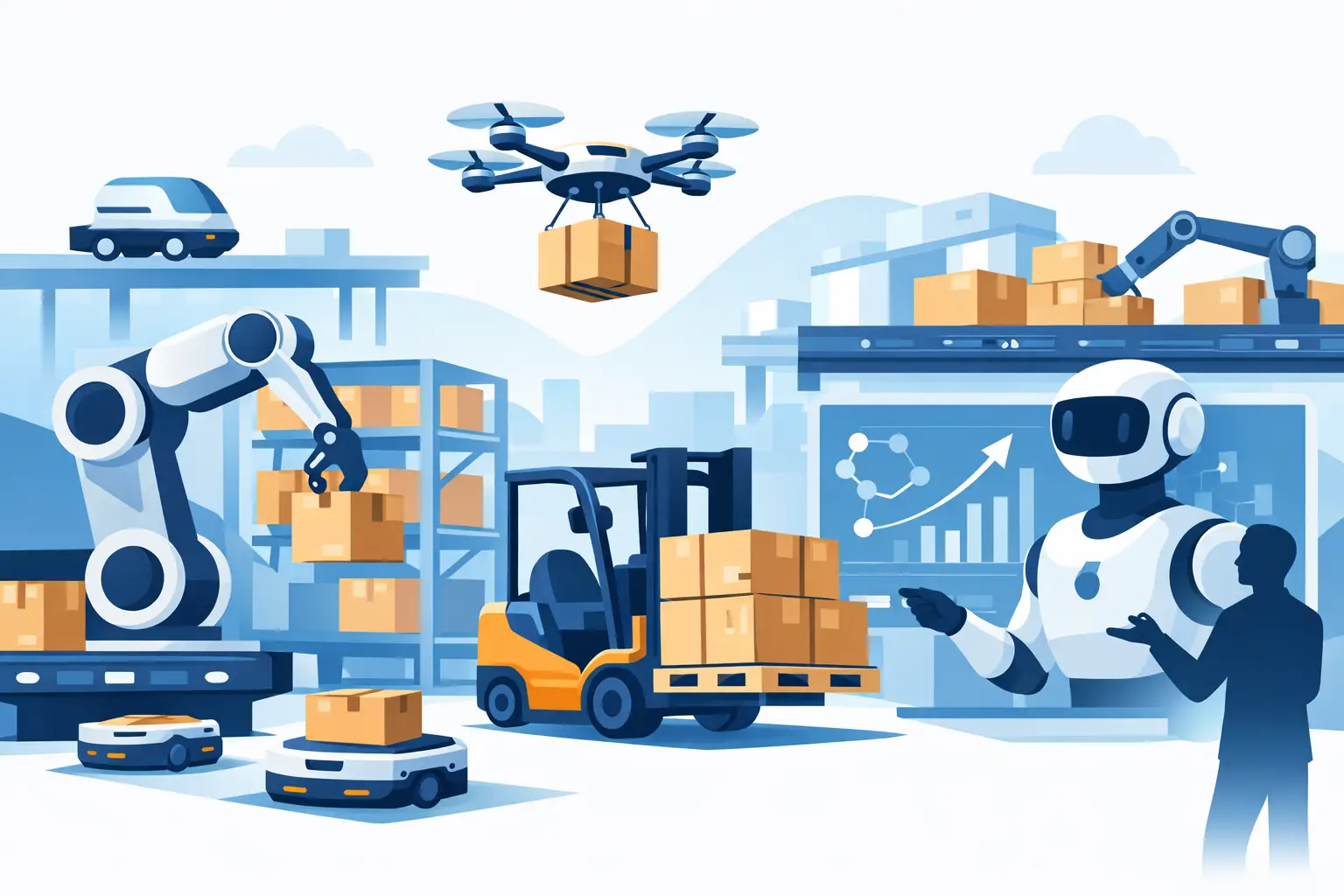
Autonomous mobile robots are moving from pilot projects into mainstream use because they address one of the most expensive warehouse activities – walking. In many operations, pickers spend a large share of their time traveling between locations rather than handling inventory. Robots that assist with transport can shorten pick cycles and improve labor productivity without requiring a full facility redesign.
Goods-to-person systems are also becoming more attractive for businesses with dense SKU profiles and high order volumes. Instead of sending workers across large floor areas, inventory is brought directly to a workstation. The productivity gains can be substantial, but the trade-off is that these systems require stronger layout planning, clearer inventory discipline, and higher upfront investment.
Automated storage and retrieval systems are advancing as well, particularly where space utilization is a priority. In urban and high-cost warehouse environments, vertical storage can improve capacity while reducing manual handling. This is especially relevant when businesses want to postpone facility expansion but still need more throughput.
Another major trend is machine vision. Cameras combined with AI are improving quality checks, barcode reading, dimensioning, and exception handling. This is not as visible as a fleet of robots on a warehouse floor, but it often delivers strong value because it improves accuracy at critical control points. In operations where returns, mis-picks, or labeling errors are expensive, vision systems can have a direct impact on service reliability.
Software is becoming the real control layer
Physical automation gets attention, but software is what makes automation useful at scale. Warehouse execution is increasingly shaped by systems that can prioritize tasks in real time, adjust labor allocation, and respond to changing order profiles during the day.
This is where warehouse management systems and warehouse control systems are evolving. They are no longer just recording activity. They are directing it. Better orchestration allows operators to release waves more intelligently, balance replenishment with picking demand, and reduce congestion at packing or dispatch.
Predictive analytics will become more common in this layer. Instead of reacting after performance drops, managers will be able to identify likely bottlenecks before they impact service. If inbound delays, labor shortages, or a sudden increase in urgent orders are likely to affect cut-off times, systems can trigger earlier intervention.
For many businesses, this will be the most practical starting point. A warehouse does not need to be heavily mechanized to become more automated. In some cases, better slotting logic, labor visibility, task interleaving, and exception alerts can deliver meaningful gains before any major equipment investment is considered.
Labor will still matter, but the work will change
One common mistake in automation planning is assuming labor becomes less important. In reality, labor becomes more specialized. As warehouses introduce more automation, the demand shifts from pure manual execution toward supervision, exception handling, system interaction, and technical support.
This creates both an opportunity and a risk. The opportunity is a safer, more stable operating environment with less dependence on constant hiring for repetitive tasks. The risk is that businesses underestimate training needs. A warehouse with new equipment but weak process ownership can underperform just as badly as a manual warehouse with labor shortages.
The strongest operations will be the ones that treat automation as workforce redesign, not just equipment installation. Teams need clear operating rules, escalation procedures, maintenance coordination, and performance accountability. In mixed environments where people and automation work side by side, process clarity becomes even more important.
Flexibility is becoming more valuable than full automation
Not every warehouse should aim for the highest possible level of automation. For many GCC businesses, demand patterns are seasonal, product ranges change, and customer requirements vary by channel. A rigid system can create problems if the operation needs to adapt quickly.
That is why one of the most important warehouse automation future trends is flexible automation. Businesses are favoring solutions that can scale by zone, function, or volume threshold instead of locking the entire facility into one model. Modular conveyor sections, robotic picking support, smart sortation, and software-led optimization allow operators to automate selectively.
This approach usually fits regional growth better. It protects capital, reduces implementation risk, and allows performance to be validated step by step. It also helps businesses align automation with actual service needs rather than broad assumptions. A high-volume e-commerce operation may need rapid order consolidation, while a B2B spare parts warehouse may benefit more from accuracy and storage density than raw pick speed.
Data accuracy will decide who gets value from automation
Automation depends on clean inputs. If item dimensions are wrong, locations are inconsistent, order priorities are unclear, or master data is poorly maintained, automation will simply expose those weaknesses faster.
This is why data discipline is becoming a competitive advantage. Businesses that standardize inventory data, maintain stronger scanning compliance, and improve SKU-level visibility will be better positioned to adopt automation successfully. The equipment matters, but data quality often determines whether the expected return is achieved.
The same applies to integration. Warehouse automation works best when inventory, transportation, order management, and customs or shipping milestones are connected. For companies managing regional freight, domestic delivery, and fulfillment together, visibility across those stages is becoming more valuable than any single automated asset.
What businesses should evaluate before investing
The right automation plan starts with operational facts, not vendor promises. Decision-makers should first identify where service breaks down most often. That could be picking congestion, receiving delays, storage limits, packing accuracy, or dispatch cut-off failures.
From there, the business case needs to be grounded in throughput, labor cost, space use, order profile, and risk exposure. A warehouse with stable high volume may justify heavier automation. A warehouse handling mixed products and variable order types may benefit more from process redesign and targeted tools. It depends on the operation, the growth plan, and the tolerance for implementation complexity.
It is also important to evaluate downtime risk, maintenance readiness, and change management. Automation can improve reliability, but only when support structures are in place. If spare parts, technician access, system support, and escalation ownership are weak, the operation may trade one type of disruption for another.
For many businesses, the best path is phased deployment with measurable milestones. That means validating one area, proving performance, and then expanding. This is often a more dependable route than pursuing a large transformation all at once.
What the next few years will likely look like
Over the next few years, warehouse automation will become less defined by headline technology and more defined by execution quality. The winners will not simply be the businesses with the most robotics or the tallest automated storage systems. They will be the businesses that improve control, maintain visibility, and connect warehouse performance to transportation and customer service outcomes.
In practice, that means more hybrid operations, stronger software orchestration, better use of machine vision, and selective automation built around real bottlenecks. It also means logistics providers will be expected to support customers with more transparency, faster fulfillment, and more consistent performance during volume swings. For operators like K-Line, the value of automation is not novelty. It is the ability to keep cargo moving accurately, on time, and with fewer operational surprises.
Businesses do not need to automate everything to move forward. They need to automate what protects service, supports growth, and gives their teams better control when volumes rise and margins tighten.