


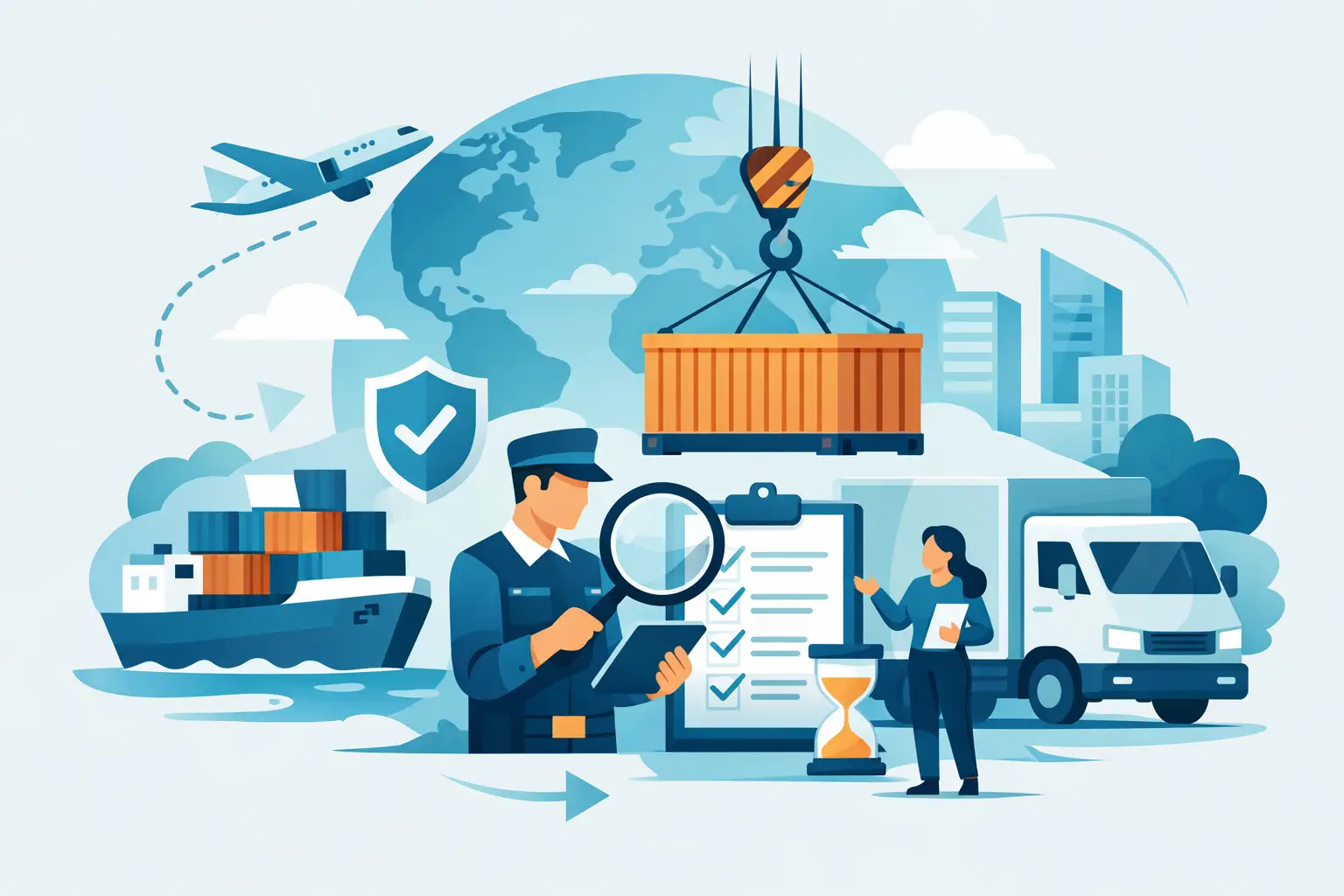
How to Streamline Customs Clearance
A shipment rarely gets delayed at customs because of one big failure. More often, it stalls because of a small mismatch – a vague product description, a missing invoice detail, the wrong HS code, or documents submitted too late. If you are looking at how to streamline customs clearance, the fastest gains usually come from fixing those repeatable process gaps before cargo reaches the border.
For businesses in Kuwait and across the GCC, customs clearance is not a side task. It affects lead times, customer commitments, storage costs, transport scheduling, and cash flow. When clearance is handled well, shipments move with less friction and better predictability. When it is handled poorly, the problem extends beyond one container or airway bill. It disrupts fulfillment plans, stock availability, and internal operations.
Why customs clearance slows down
Customs clearance becomes difficult when commercial, logistics, and compliance teams work with different information. Procurement may order one product specification, the supplier may describe it another way on the invoice, and the transport team may book the cargo under a broader category. That gap creates questions at inspection or document review stage.
Another common issue is timing. Many businesses prepare customs documents after the shipment is already moving. That leaves too little room to correct errors, confirm permit requirements, or align consignee details. In high-volume operations, even minor inconsistencies can create repeated delays across multiple shipments.
There is also the compliance factor. Not every shipment follows the same path. Product category, country of origin, declared value, restricted goods rules, and destination requirements all affect clearance. A process that works for general merchandise may fail for electronics, regulated items, promotional bundles, or shipments with mixed SKUs.
How to streamline customs clearance at the source
The best way to reduce customs delays is to treat clearance as part of shipment planning, not as an end-of-line administrative step. That means building control earlier in the process, where errors are easier and cheaper to fix.
Standardize your product data
Customs teams can only work with the information they receive. If your product names vary from order to order, classification becomes slower and more vulnerable to mistakes. A clear internal product master helps avoid this.
Each SKU should have a consistent commercial description, material composition where relevant, country of origin, declared use, and the preferred HS code where appropriate. The description should be specific enough for customs purposes, not just useful for sales. “Spare parts” or “accessories” is too broad. “Automotive brake pads” or “plastic food storage containers” is far more workable.
This matters even more for businesses managing e-commerce or retail replenishment. Large shipment volumes make manual correction difficult. Standardized data creates repeatability, and repeatability is what speeds up clearance.
Get documents right before cargo moves
Most customs problems can be traced back to incomplete or inconsistent paperwork. Commercial invoices, packing lists, certificates of origin, permits, and transport documents should align exactly on shipper details, consignee details, quantities, values, and item descriptions.
The invoice deserves extra attention. It should reflect the actual transaction clearly, including unit values, total value, currency, incoterms where relevant, and a meaningful goods description. If customs sees generic wording or numbers that do not match the packing list, questions follow.
It also helps to set a pre-departure document check. That step is simple but effective. Before cargo is loaded or dispatched, someone should verify that all required documents are present and internally consistent. For frequent importers, this should be a formal checkpoint rather than an informal review.
Classify goods correctly
Classification errors cause avoidable delays, and they can also affect duty calculations, permit checks, and compliance risk. If a shipment is repeatedly classified differently by different teams or suppliers, your process is not under control.
Correct classification depends on the exact nature of the goods. Material, function, composition, and intended use can all change the result. That is why businesses should not rely on guesswork or copy old codes blindly from unrelated shipments. Similar products can still require different treatment.
In practice, it helps to maintain an approved classification file for recurring items and review it periodically, especially when product specifications change. This is one area where working closely with an experienced customs handling team saves time, because they can identify mismatches before they become port or airport delays.
Build a process around visibility, not reaction
A reactive customs process usually starts with asking what went wrong after a shipment is already held. A controlled process asks earlier whether anything is likely to go wrong at all.
Share one version of shipment information
Operations teams, suppliers, freight coordinators, warehouse staff, and customs handlers should all work from the same shipment data. If one party uses a pro forma invoice and another uses an updated commercial invoice, discrepancies become almost inevitable.
A shared workflow reduces that risk. Even if your tools are simple, the principle is the same: one confirmed set of shipment details, one document set, and one owner responsible for final validation. Without ownership, errors pass between teams and become expensive at clearance stage.
Use pre-arrival review when possible
Pre-arrival preparation is one of the most effective ways to streamline customs clearance. When documents are reviewed before cargo lands or reaches the border, missing details can be corrected without adding immediate storage or demurrage pressure.
This approach is especially useful for time-sensitive freight, retail launches, and replenishment shipments tied to stock availability. It does require discipline upstream. Suppliers must send documents on time, and internal teams must review them quickly. But the trade-off is worth it for businesses that depend on predictable lead times.
Track repeat exceptions
If the same customs issue appears more than once, it is no longer an exception. It is a process weakness. Businesses should track the reason behind each customs delay, whether it was a valuation query, documentation mismatch, permit issue, classification problem, or consignee data error.
That visibility turns customs into a measurable function rather than a black box. Over time, you can identify which suppliers create the most corrections, which product lines trigger reviews, and which routes need earlier preparation. Reliable operations come from this kind of process discipline.
Work with partners who can reduce handoff risk
Customs clearance tends to slow down when too many providers are involved without clear accountability. One company books freight, another stores cargo, a third handles local transport, and a separate broker receives incomplete information late in the process. Every handoff introduces another chance for error.
For many businesses, the practical way to streamline customs clearance is to reduce those handoffs. When freight, warehousing, local transport, and customs support are better coordinated, document flow improves and issues are escalated faster. That does not mean every shipment needs the same model. Some businesses benefit from specialized providers for certain commodities or lanes. But fragmented responsibility usually costs time.
This is particularly relevant for companies with frequent inbound shipments into Kuwait or the GCC. If your business depends on regular stock movement, you need a logistics setup that can support customs with accurate data, document readiness, and operational follow-through. That is where an integrated logistics partner such as K-Line can add value – not just by moving cargo, but by reducing the process gaps that create clearance delays in the first place.
Plan for the shipments that are more likely to be questioned
Not every shipment should be treated the same way. High-value cargo, mixed commodity loads, promotional assortments, regulated products, and first-time imports often need more careful preparation than repeat shipments of standard goods.
That is where judgment matters. Over-processing every shipment creates unnecessary admin work. Under-processing complex shipments creates delays. The right approach is risk-based planning. Put more review into the shipments most likely to attract customs questions, and keep a streamlined path for repeat cargo with established documentation and product data.
This balance matters for growing businesses. As volume increases, teams often try to speed everything up at once. But scale without controls usually increases exceptions. A better model is controlled acceleration – standardize what repeats, review what changes, and make sure someone owns compliance before cargo arrives.
How to streamline customs clearance without sacrificing control
Speed and control are not opposites in customs clearance. In fact, the fastest operations are usually the ones with the strongest discipline. Clear product data, accurate documents, consistent classification, pre-arrival checks, and coordinated partners all reduce uncertainty. That is what keeps cargo moving.
There is no single fix that works for every importer, exporter, or commodity. Some delays come from internal document quality. Others come from supplier inconsistency, permit requirements, or poor coordination across logistics providers. But the pattern is consistent: businesses that treat customs as a managed process rather than a last-minute task see better transit reliability and fewer operational surprises.
If your shipments are still depending on manual fixes, email chains, and urgent corrections after arrival, the process is already telling you where the risk sits. Tightening that workflow now will protect more than clearance times. It will protect inventory flow, customer commitments, and your ability to scale without disruption.
The most useful question is not how fast one shipment can clear. It is how consistently your business can clear the next hundred.