


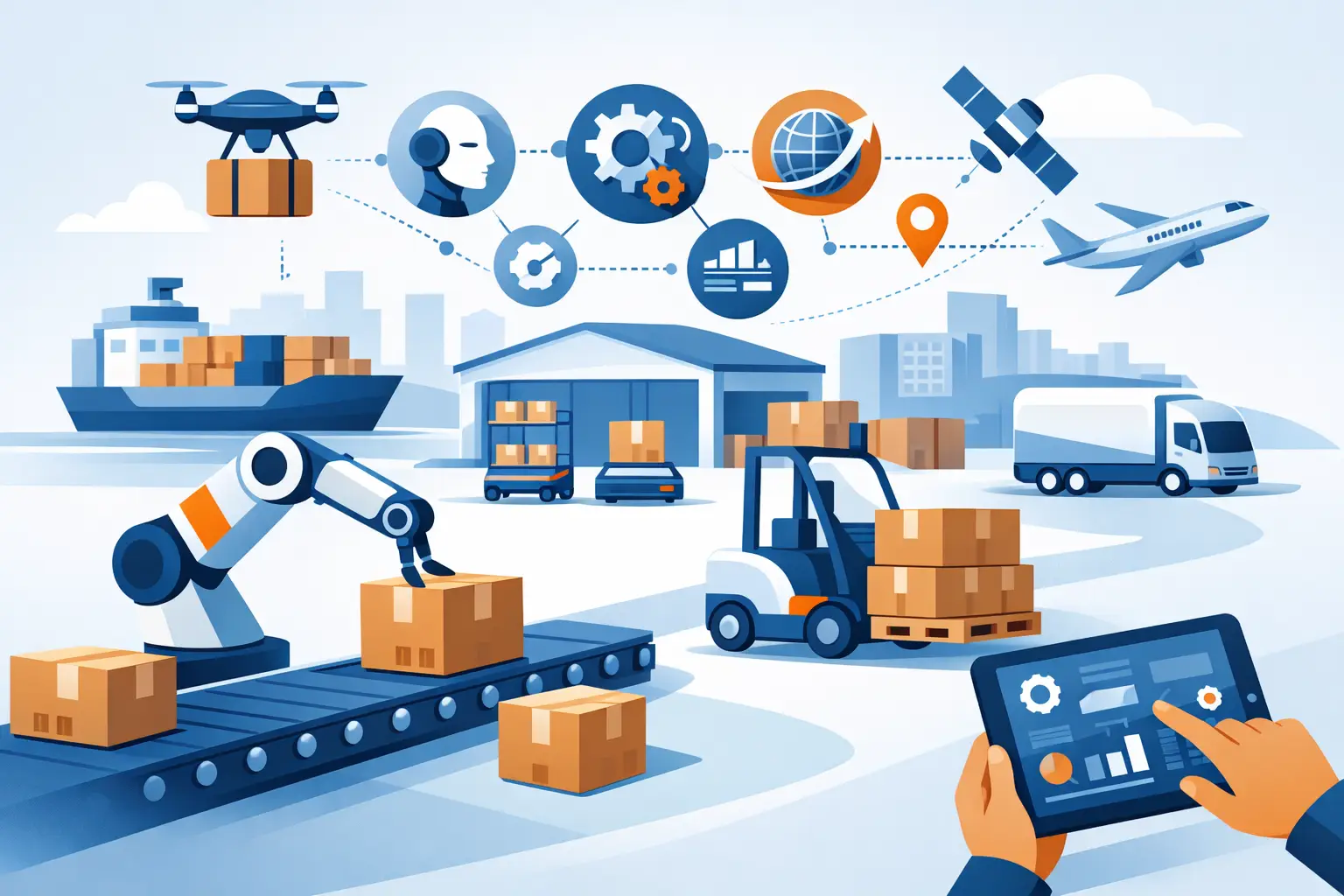
Logistics Automation Trends That Improve Control
A delayed order is rarely caused by one missed scan or one late vehicle. More often, it is the result of disconnected warehouse, transport, customs, and customer-service processes. The most valuable logistics automation trends address those handoffs. For businesses shipping within Kuwait, across the GCC, or internationally, the goal is not automation for its own sake. It is better control over cargo, inventory, delivery promises, and exceptions.
Automation is changing how freight forwarders, warehouse operators, retailers, and e-commerce businesses plan daily work. It can reduce manual data entry, accelerate order processing, improve inventory accuracy, and give operations teams earlier warning when a shipment needs attention. However, technology only delivers those gains when the underlying process is defined, the data is reliable, and people remain responsible for decisions that require judgment.
Logistics Automation Trends Shaping Daily Operations
The strongest trend is connected operational visibility. Businesses no longer want tracking information to exist in separate portals for air freight, sea freight, land transport, warehousing, and final-mile delivery. They need a usable view of the shipment lifecycle, from booking and pickup through customs clearance, storage, dispatch, and proof of delivery.
This visibility depends on integrations between transportation management systems, warehouse management systems, customer order platforms, carrier tools, and customs documentation processes. When information moves automatically between these systems, teams spend less time asking where an order is and more time resolving the reason it may be delayed. For a business handling frequent shipments, that difference protects customer service and reduces avoidable follow-up work.
Automated order capture and routing
Manual order entry remains a common source of shipping errors. An incorrect address, service level, commodity description, or contact number can create delays that are expensive to correct after a shipment has left the warehouse. Automated order capture pulls approved order data into fulfillment and transportation workflows, reducing repetitive typing and creating a clearer record from the start.
Routing automation is becoming more practical for domestic delivery and regional distribution. Systems can group deliveries by location, delivery window, vehicle capacity, and service priority. The right route is not always the shortest distance. A route may need to account for customer receiving hours, vehicle restrictions, high-priority orders, or the need to collect returns. Operations teams should be able to override system recommendations when local conditions require it.
Warehouse execution with real-time inventory data
Warehouses are moving beyond simple stock records toward task-based execution. Barcode scanning, mobile devices, location controls, and system-directed picking help teams confirm that the correct item is picked, packed, staged, and loaded. This is particularly relevant for e-commerce fulfillment, FMCG distribution, spare parts, and B2B replenishment, where a small picking error can affect a customer relationship or a production schedule.
Automation also improves replenishment decisions. When inventory levels, open orders, inbound shipments, and storage locations are visible together, warehouse managers can plan labor and space before congestion develops. During peak demand, this can be more valuable than adding technology that looks impressive but does not solve the actual bottleneck.
Physical automation, including conveyors, sortation equipment, automated storage, and robotics, is also expanding. Its value depends on shipment volume, SKU profile, building layout, and labor availability. A high-volume operation with repeatable order patterns may justify equipment investment. A warehouse handling varied project cargo, irregular dimensions, or changing customer requirements may gain more from scanning discipline and flexible process automation first.
Predictive exception management
Traditional tracking reports tell customers that a shipment is late after the delay has occurred. Predictive exception management aims to identify risk earlier. It uses shipment milestones, historical transit performance, traffic patterns, capacity information, document status, and operational alerts to flag orders that may miss their expected delivery date.
This approach changes the role of the operations team. Instead of monitoring every shipment equally, staff can focus on exceptions with commercial impact: a critical production component, an urgent retail replenishment order, temperature-sensitive cargo, or a shipment approaching a customs deadline. Automated alerts do not replace experienced operators. They help those operators direct their attention where it matters most.
Digital customs and compliance workflows
For cross-border freight, incomplete or inconsistent documentation can stop cargo at the point where speed matters most. Digital customs workflows help standardize commercial invoices, packing lists, commodity details, permits, and supporting records before cargo reaches a border or airport.
Automation can validate required fields, flag missing documents, and maintain a record of approvals and changes. This is especially useful for organizations with frequent imports, multiple suppliers, or regulated commodities. Still, compliance cannot be treated as a fully automated checkbox. Classification, valuation, country-specific requirements, and unusual cargo conditions often require review by experienced customs professionals.
Where Automation Produces Measurable Value
Businesses should assess automation against operational outcomes, not broad technology claims. The most useful measures are usually order processing time, inventory accuracy, on-time dispatch, delivery performance, exception resolution time, documentation error rates, and the cost to fulfill each order. These measures show whether a system is improving execution or simply adding another dashboard.
For e-commerce businesses, the priority may be faster order release, accurate picking, delivery notifications, and returns processing. For a B2B supplier, it may be scheduled delivery compliance, proof of delivery, inventory availability, and account-level reporting. Industrial operators may place greater weight on freight milestones, customs documentation, cargo handling controls, and delivery coordination for critical equipment.
The right automation plan therefore depends on the service model. A business sending a few high-value international shipments each month has different needs from a retailer processing thousands of local orders each day. Trying to apply the same technology stack to both can create unnecessary cost and complexity.
Logistics Automation Trends Need Clean Data and Clear Ownership
Automation exposes process weaknesses quickly. If product dimensions are inaccurate, warehouse locations are not maintained, customer addresses are incomplete, or service rules are unclear, faster data movement can spread errors faster. Before introducing new tools, businesses should define ownership for master data, order changes, inventory adjustments, carrier updates, and customer communication.
A controlled rollout is usually more effective than a large, disruptive implementation. Start with one process that creates repeatable friction, such as manual order entry, delivery status calls, or inventory reconciliation. Establish a baseline, test the workflow, train the teams using it, and measure the result. Once the process is stable, the business can extend the same controls to other functions.
This approach matters in the GCC, where logistics operations often combine domestic delivery, regional transport, international freight, customs coordination, and seasonal volume changes. A system that works well in one lane may require different rules for another. Local operating knowledge remains essential, particularly where delivery access, documentation standards, or customer receiving practices vary.
The Role of People in an Automated Operation
Automation should remove repetitive work, not remove accountability. Customers still need a responsible point of contact when cargo is delayed, an order changes, or a customs question requires immediate action. Warehouse teams still need to identify damaged stock. Transport coordinators still need to make practical decisions when a vehicle issue or urgent request changes the plan.
The best operating model combines accurate systems with trained people and defined escalation paths. K-Line applies this principle across freight, warehousing, customs handling, and delivery operations: visibility supports action, but operational ownership keeps shipments moving. For commercial customers, that combination is more useful than technology that reports a problem without resolving it.
Preparing Your Business for the Next Step
Begin by mapping the journey of one order from customer request to final delivery. Identify each manual handoff, repeated data entry point, approval delay, and status update that depends on a phone call or spreadsheet. Then determine which issue creates the greatest impact on customer experience, cost, or business continuity.
The best next step may be a simple integration, better barcode discipline, structured delivery alerts, or a clearer exception workflow rather than a major capital project. Choose the improvement that gives your team earlier control over the shipment, then build from there. Reliable logistics is not defined by how much technology is installed. It is defined by how consistently your cargo moves when the operation is under pressure.