


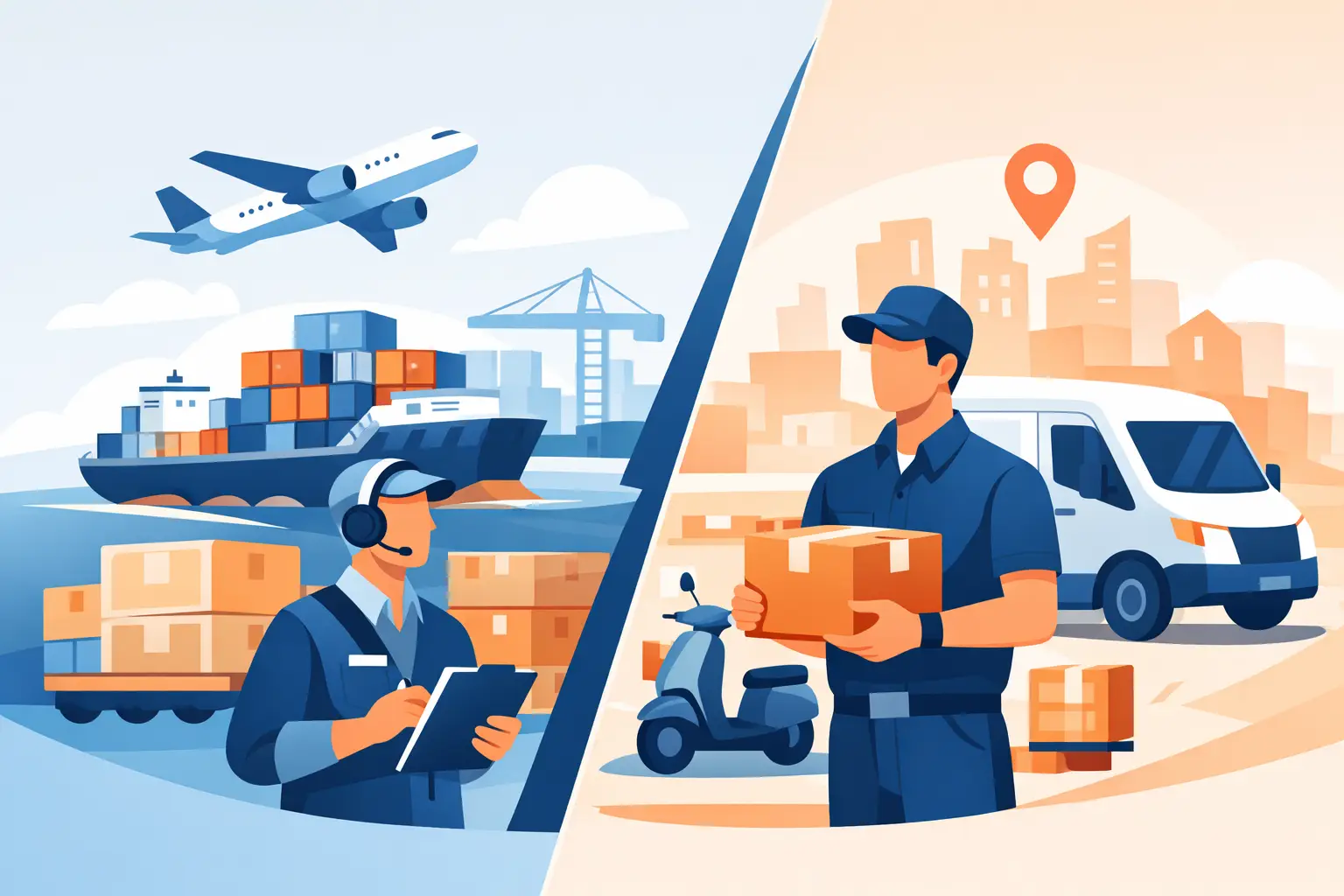
Freight Forwarder vs Courier: Which Fits?
A late shipment does more than miss a delivery window. It can interrupt production, delay retail replenishment, trigger customer complaints, or create customs issues that spread across the rest of your operation. That is why the freight forwarder vs courier decision matters more than many businesses expect.
These two shipping models solve different problems. A courier is built for speed, parcel movement, and straightforward door-to-door delivery. A freight forwarder is built for cargo planning, route management, customs coordination, documentation, and larger or more complex shipments. If your team ships regularly across Kuwait, the GCC, or international lanes, choosing the wrong model can increase cost, reduce visibility, and create avoidable delays.
Freight forwarder vs courier: the core difference
The simplest way to separate them is by shipment profile.
A courier usually handles smaller packages, documents, samples, and time-sensitive deliveries with a defined transit network. The process is standardized. You book, label, hand over the shipment, and the courier moves it through its existing system.
A freight forwarder manages cargo movement rather than just parcel delivery. That can include air freight, sea freight, land transport, consolidation, customs clearance, storage, and final delivery planning. The forwarder may not operate every aircraft, truck, or vessel directly, but it controls how the shipment moves from origin to destination.
For a business, this difference is operational. A courier is often a transport product. A freight forwarder is a logistics function.
When a courier is the better fit
If you are sending small, urgent, and relatively simple shipments, a courier is usually the right call. This is common for replacement parts, legal documents, product samples, small e-commerce parcels, or low-volume B2B deliveries where speed matters more than shipment customization.
Couriers work best when the cargo fits standard size and weight thresholds, the destination is already covered by the network, and the shipment does not require special routing or handling. Pricing is usually easier to estimate upfront because the shipment moves through a fixed rate structure based on dimensions, weight, destination, and service level.
That said, speed does not always mean flexibility. Once a parcel enters a courier network, your options for changing routing, storage, bundling, or customs handling can be limited. For businesses with repetitive, small-package shipping, that can be acceptable. For businesses managing inventory flow, bulk replenishment, or regulated cargo, it often is not enough.
When a freight forwarder is the better fit
A freight forwarder is the stronger choice when the shipment is larger, more valuable, more frequent, or more operationally sensitive. This applies to palletized cargo, commercial stock, industrial equipment, retail replenishment, imported goods requiring customs coordination, and multi-stage shipments that need storage or regional distribution.
Forwarders add value by planning the shipment around your business requirement instead of forcing the shipment into a fixed parcel system. That can mean choosing air instead of sea for urgent stock, consolidating multiple suppliers into one movement, arranging customs paperwork before arrival, or connecting freight transport with warehousing and last-mile delivery.
For commercial shippers, that level of control often matters more than raw transit speed. A shipment that arrives quickly but stalls at customs or reaches the wrong delivery point still creates operational damage. Freight forwarding is designed to reduce those points of failure.
Cost is not as simple as cheap vs expensive
Many companies assume couriers are cheaper and freight forwarders are more expensive. Sometimes that is true, but only for small and uncomplicated shipments.
Couriers are cost-effective for documents and parcels because their networks are optimized for volume and repetition. But once shipments become heavier, bulkier, or more frequent, courier pricing can rise quickly. Dimensional weight charges, remote area fees, multiple parcel handling, and premium express rates can make a courier model inefficient for commercial cargo.
Freight forwarders may look more complex on paper, but they often improve total shipping economics for businesses moving regular stock or larger volumes. Consolidation, route planning, mode selection, and customs coordination can reduce hidden costs such as storage delays, failed delivery attempts, split shipments, and stockouts.
The better question is not which model has the lower headline rate. It is which model lowers total landed cost while protecting delivery performance.
Customs, compliance, and documentation
This is where the freight forwarder vs courier comparison becomes more serious for business shipments.
Couriers can handle customs for standard parcel traffic, especially for simple commercial invoices and lower-risk goods. But the service is still built around a defined process. If your shipment requires detailed classification, supporting permits, pre-clearance planning, or coordinated communication with multiple parties, the courier model may become restrictive.
Freight forwarders are built for this layer of logistics. They manage shipping documents, coordinate customs clearance, align transport timing with border procedures, and help reduce the risk of non-compliance. For businesses shipping across GCC markets or importing regulated products, that support can prevent delays that cost far more than the freight itself.
This is particularly relevant for organizations handling frequent commercial imports, government-related shipments, controlled products, or high-value cargo. In those cases, logistics is not just about movement. It is about execution under rules.
Visibility and control across the shipment lifecycle
Courier tracking is usually fast and user-friendly. You can often see collection, transit checkpoints, customs status, and delivery confirmation in a standardized format. For one-off parcels, that works well.
But business logistics often require more than status updates. Operations teams may need milestone visibility across pickup, linehaul, customs, warehousing, re-dispatch, and final delivery. They may also need one point of accountability when a shipment touches multiple stages.
That is where freight forwarding becomes more valuable. A forwarder can provide visibility not only into where the cargo is, but also what is happening around it – whether documents are complete, whether cargo is waiting for clearance, whether storage is required, or whether delivery should be rescheduled to fit site operations.
For companies managing inventory continuity, that broader control is often the deciding factor.
Speed depends on what you are shipping
Couriers are generally faster for small, urgent consignments. That is their strength, and for many business needs it is the right answer.
But speed should be judged against shipment type. A courier may move a parcel faster than a freight forwarder, yet a forwarder may move a commercial shipment more effectively because the transport plan fits the cargo. Air freight can still be arranged through a forwarder for urgent stock, while customs, handling, and delivery are coordinated properly around the shipment.
So yes, couriers often win on parcel transit time. Freight forwarders often win on overall shipment execution.
Which model works best for common business scenarios?
If you run e-commerce and ship individual customer orders daily, a courier is usually the practical fit for last-mile and parcel distribution. If you are moving inbound inventory from suppliers, especially in larger loads, a freight forwarder is usually the better fit.
If you are an FMCG distributor replenishing retail channels, courier services may help with urgent document or sample delivery, but core stock movement typically belongs with freight and distribution planning. If you manage industrial or project cargo, the choice usually leans even more heavily toward freight forwarding because weight, handling, permits, and route control matter.
Many businesses do not need to choose one forever. They need the right model for each shipment category.
The smartest decision is often a combined logistics setup
For growing businesses, the real answer is not courier or freight forwarder in isolation. It is building a shipping structure that matches your operating model.
You might use courier services for urgent parcels, service parts, and direct customer deliveries, while relying on a freight forwarder for international stock movement, customs clearance, storage, and regional distribution. That split gives you speed where speed matters and control where complexity matters.
This is especially useful for companies that are scaling. As shipment volume increases, what starts as a simple parcel operation often becomes a broader logistics requirement. Storage, fulfillment, customs, and recurring freight coordination start to matter more than single-shipment convenience.
That is where an integrated logistics partner can reduce friction. A provider such as K-Line can support cargo movement, warehousing, customs handling, and delivery under one operating structure, which helps businesses avoid the handoff problems that slow down supply chains.
How to decide with confidence
Start with four questions. What are you shipping? How often do you ship it? What happens if it is delayed? And how much coordination does the shipment require before it can actually be delivered?
If the answer points to small, urgent, low-complexity packages, use a courier. If it points to commercial cargo, recurring inventory flow, customs exposure, or multi-stage handling, use a freight forwarder.
The right shipping model should support business continuity, not just movement. When your logistics decision matches the reality of your cargo, you get fewer exceptions, clearer accountability, and better control over cost and service. That is usually the difference between shipping that looks fast and shipping that actually works.