


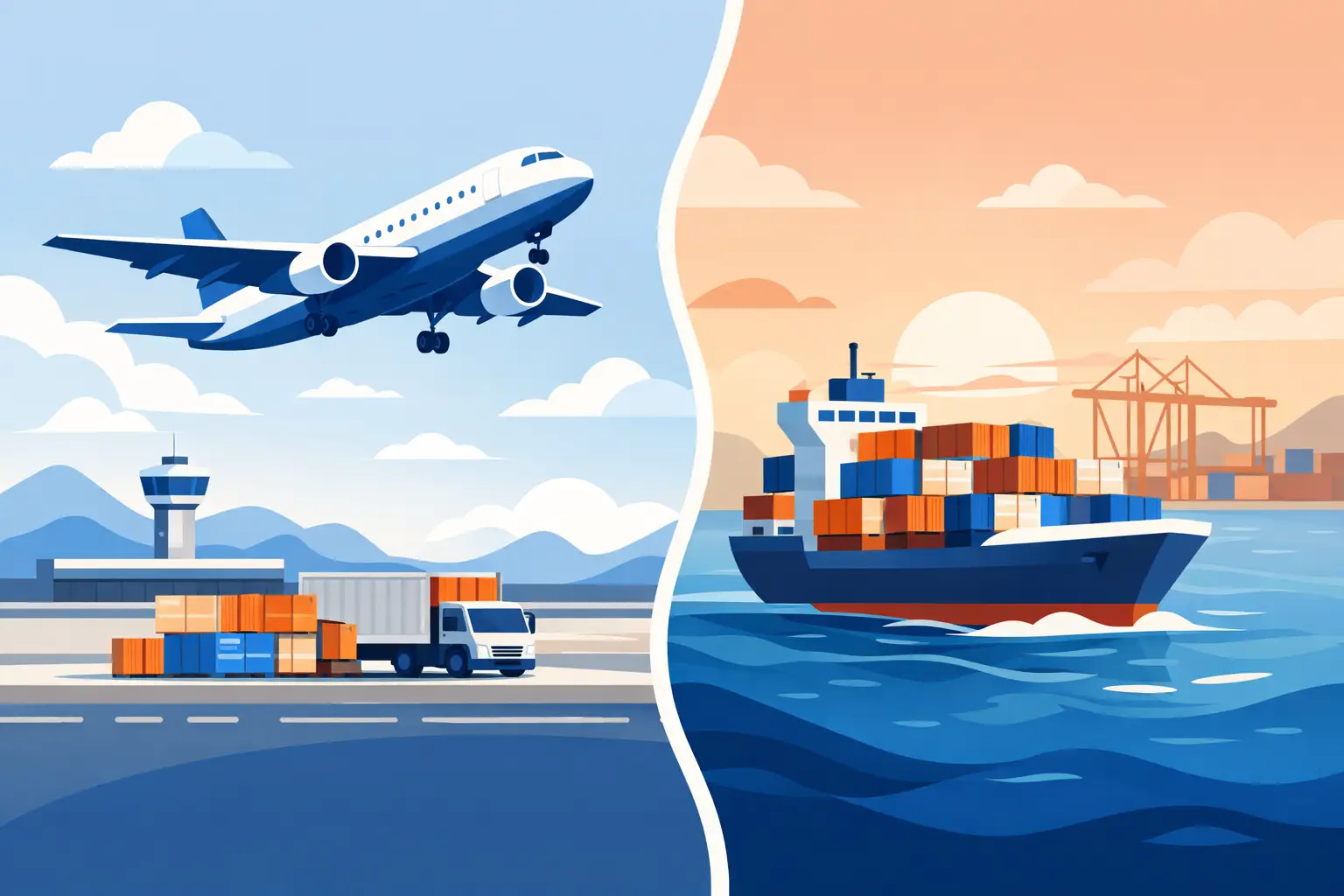
Air Freight vs Sea: Which Fits Your Cargo?
A delayed container can stall a promotion, leave shelves empty, or force costly last-minute purchasing. That is why the air freight vs sea decision matters long before cargo reaches the port or airport. For businesses in Kuwait and across the GCC, the right choice is less about preference and more about protecting lead times, margins, and operational continuity.
Air and sea freight solve different problems. One gives you speed and tighter transit windows. The other gives you lower unit costs and greater volume capacity. The better option depends on what you are shipping, how often you ship, what a delay would cost your business, and how much flexibility exists in your inventory plan.
Air freight vs sea: the real business trade-off
At a basic level, air freight is built for urgency. It supports high-value, time-sensitive, or fast-moving cargo that cannot afford long transit cycles. Sea freight is built for efficiency at scale. It is usually the more economical option for larger loads, lower-value goods, and replenishment schedules that can tolerate longer lead times.
The mistake many businesses make is comparing only freight rates. Freight cost matters, but it is only one part of the total landed cost. If sea freight saves money on transportation but leads to stockouts, production delays, missed delivery commitments, or excess safety stock, the apparent savings can disappear quickly. In the same way, shipping by air for every order may protect service levels but put unnecessary pressure on margins.
For most businesses, the question is not whether air is better than sea or the reverse. The question is which mode fits the shipment profile and the business consequence of delay.
When air freight is the right choice
Air freight is usually the stronger option when time is the main constraint. If your cargo supports a product launch, urgent replenishment, a customer deadline, or a production line, speed has real financial value. A faster transit can reduce the need for large buffer stock and allow purchasing teams to respond more quickly to actual demand.
This matters especially for e-commerce, retail restocking, electronics, medical supplies, automotive parts, and selected FMCG lines with short sales windows. Air freight can also make sense for high-value cargo where transportation cost is a smaller percentage of the product value.
There is also a planning advantage. Air schedules are often easier to use when a business needs shorter order cycles and closer inventory control. If your operation is managing frequent shipments with changing demand patterns, air freight provides flexibility that ocean shipping usually cannot match.
That said, speed comes at a price. Air freight is typically much more expensive per kilogram than sea freight. Weight and dimensional weight calculations can also make light but bulky cargo surprisingly costly. Capacity constraints, handling rules, and commodity restrictions can affect what can move by air and how quickly it can be booked.
When sea freight makes more sense
Sea freight is the standard choice when cost efficiency and volume matter more than transit speed. If you are moving heavy cargo, palletized goods, oversized shipments, or regular replenishment stock, ocean shipping often offers the best economics.
For importers and distributors working on planned purchasing cycles, sea freight supports scale. It allows businesses to consolidate larger quantities, lower transportation costs per unit, and move cargo in a way that aligns with long-range inventory planning. This is often the better fit for furniture, construction materials, industrial equipment, bulk consumer goods, and many general trading shipments.
Sea freight also gives businesses more flexibility in container usage. Full container load and less than container load options can support both large-volume and shared-volume strategies depending on shipment size and frequency.
The trade-off is time. Ocean transit is slower, and it is often less predictable than teams expect when they first compare quotes. Port congestion, transshipment delays, customs documentation issues, and inland coordination can all extend actual delivery time. If your supply chain is already tight, sea freight can expose weak planning very quickly.
Cost is more than the freight rate
A lower quote does not always mean a lower total cost. When comparing air freight vs sea, procurement and operations teams should look beyond line-haul pricing.
Air freight usually carries higher direct shipping costs, but it can lower inventory holding costs, reduce warehousing pressure, and shorten the cash conversion cycle. Your goods arrive faster, which means capital is tied up for less time. For fast-moving or seasonal products, that can be a meaningful advantage.
Sea freight usually wins on pure transportation economy, especially for heavier and larger shipments. But slower movement may require larger purchase quantities, more storage space, higher safety stock, and earlier commitment to demand forecasts. If the forecast is wrong, the business can end up carrying excess inventory or reacting too slowly to market changes.
For many GCC importers, this is where the real decision is made. The best mode is the one that supports the full operating model, not just the freight budget.
Transit time and reliability are not the same thing
Many businesses focus on speed, but reliability deserves equal attention. A shipment that takes longer but arrives consistently can be easier to plan around than a faster option with irregular execution.
Air freight usually offers shorter transit windows and better suitability for urgent movements. It can be the safer choice when a missed deadline would affect customer commitments or business continuity. However, air cargo can still face cut-off times, screening requirements, airline capacity issues, and delays related to documentation or special handling.
Sea freight offers consistency when schedules are planned properly, but it has more moving parts. Vessel schedules, terminal congestion, feeder connections, and customs coordination all influence final delivery timing. That does not make sea freight unreliable by default. It means the shipment needs stronger planning discipline and realistic lead time assumptions.
This is where visibility and execution matter. Businesses do not just need transportation. They need coordinated handling, customs support, and status tracking that reduce uncertainty from origin to final delivery.
Cargo type changes the answer
The nature of the cargo often decides the mode before the budget does. Fragile, high-value, urgent, or perishable goods often lean toward air freight because the risk of delay or prolonged handling is too high. Heavy, dense, non-urgent, or bulky cargo generally leans toward sea because the economics are better suited to the shipment.
Compliance also matters. Some products face restrictions, documentation requirements, or handling standards that affect whether air or sea is practical. Dangerous goods, regulated items, and specialized commodities should be evaluated early, not after booking begins.
If your business ships mixed product categories, the right answer may be to split the flow. Critical SKUs can move by air while core replenishment stock moves by sea. That approach helps control cost without putting service levels at risk.
Air freight vs sea for GCC supply chains
For businesses serving Kuwait and the wider GCC, the decision often comes down to balancing regional demand speed with import economics. Companies with aggressive fulfillment targets, promotional calendars, or customer delivery commitments may need air freight for selected lanes or urgent replenishment. Businesses with stable forecasting and higher-volume import cycles often gain more from sea freight and planned inventory positioning.
The strongest supply chains usually do not rely on one mode alone. They use sea freight as the base plan and air freight as a control tool for exceptions, urgent orders, launch inventory, or recovery from disruption. That kind of mode planning gives commercial teams more flexibility without letting logistics costs drift out of control.
A capable logistics partner can make that decision easier by aligning freight mode with warehousing, customs clearance, and final delivery. When transport, storage, and clearance are handled in a coordinated way, businesses gain more control over actual delivery performance, not just shipment departure dates.
How to choose with confidence
A practical way to decide is to ask four operational questions. First, what does a delay cost the business in lost sales, penalties, or disruption? Second, what percentage of product value can the shipment absorb in transportation cost? Third, how predictable is demand for this cargo? Fourth, does the business have enough inventory buffer to use a slower mode safely?
If delay is expensive, demand is volatile, and the cargo value is high, air freight is often justified. If the shipment is heavy, forecastable, and part of planned replenishment, sea freight is usually the stronger choice. If the answer is mixed, the shipment strategy should be mixed too.
For many businesses, the best logistics decision is not the cheapest or the fastest on paper. It is the one that protects service, keeps inventory in control, and supports steady execution across the supply chain. That is the standard worth using when the next shipment is on the line.