


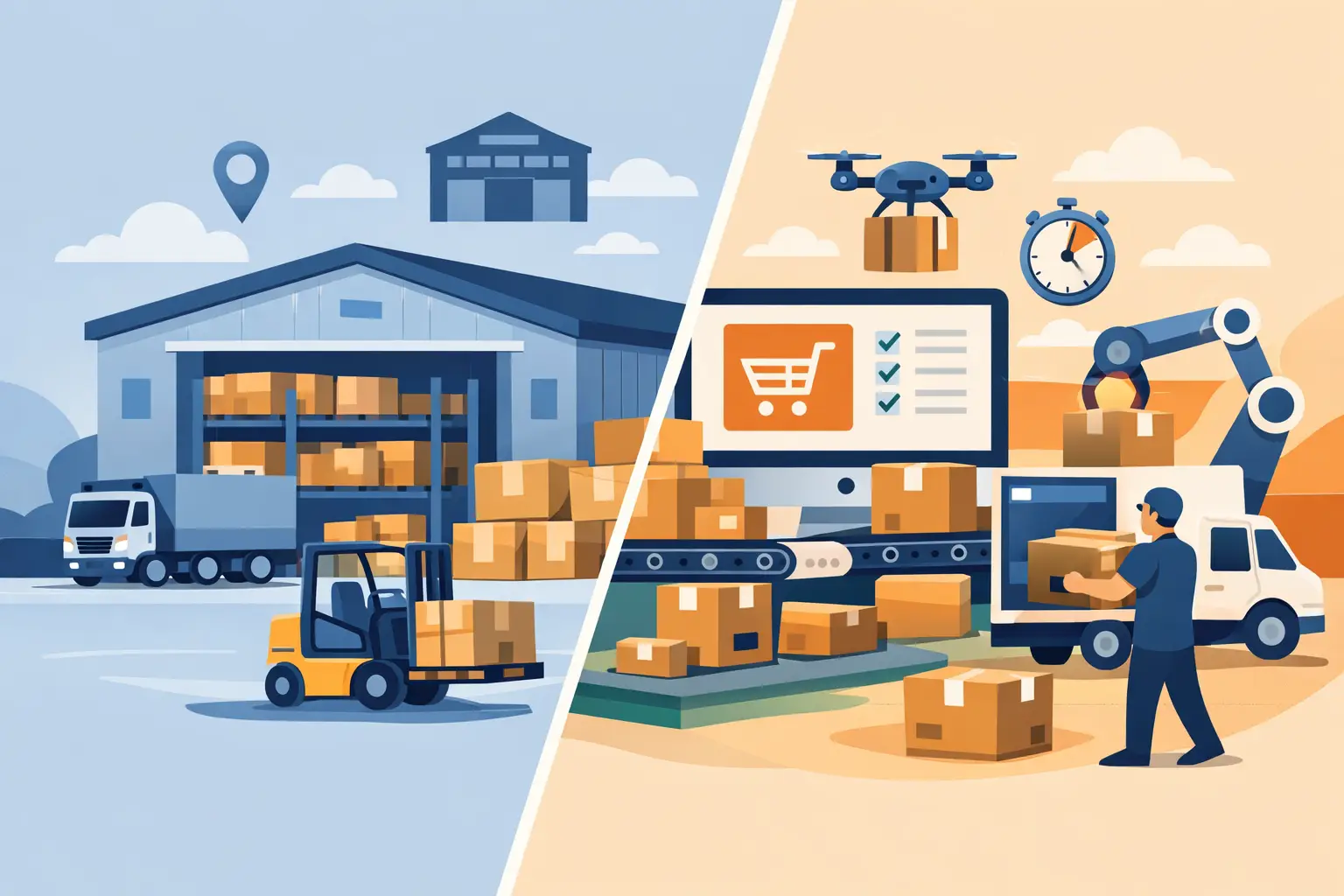
Warehousing vs Fulfillment Services
A business can have plenty of stock on hand and still disappoint customers if orders are not picked, packed, and dispatched on time. That is where the difference between warehousing vs fulfillment services becomes operational, not just semantic. For companies managing inventory in Kuwait and across the GCC, the right model affects delivery speed, working capital, staffing pressure, and customer experience.
The two services are closely related, but they solve different problems. Warehousing is primarily about storing goods safely and maintaining inventory availability. Fulfillment services add the active order-handling layer that moves products from storage to the customer. If your business is evaluating capacity, delivery expectations, or regional scale, understanding that distinction helps prevent expensive mismatches.
What warehousing means in practice
Warehousing is the structured storage of inventory inside a managed facility. Its core function is to hold goods securely, keep them organized, and make them accessible when needed. For many businesses, that includes pallet storage, shelf storage, batch control, inbound receiving, stock counting, and inventory reporting.
A warehousing operation is usually designed around stability and control. Businesses use it when they need a place to hold goods before distribution, support seasonal stock buildup, or maintain buffer inventory for ongoing sales. Retailers, importers, distributors, and industrial suppliers often rely on warehousing because they need physical capacity before they need daily order processing.
That does not mean warehousing is passive. A strong warehouse operation still depends on disciplined receiving, inventory accuracy, location management, and damage prevention. But the main objective is storage efficiency and stock visibility, not rapid order dispatch.
What fulfillment services include
Fulfillment services start with storage, but they do not stop there. They are built to process customer orders. That usually includes receiving inventory, storing it, managing stock data, picking items when orders arrive, packing them correctly, preparing shipping labels, handing off shipments to delivery networks, and often managing returns.
In other words, fulfillment turns inventory into outbound orders. It is especially relevant for e-commerce sellers, high-volume retailers, subscription businesses, and brands that need frequent direct-to-customer or direct-to-store deliveries. The value is not just where inventory sits. The value is how quickly and accurately inventory moves.
A fulfillment operation is more time-sensitive than basic warehousing. It requires process discipline, system coordination, cutoff-time management, and transportation integration. If the warehouse is the inventory base, fulfillment is the execution engine.
Warehousing vs fulfillment services: the core difference
The simplest way to compare warehousing vs fulfillment services is this: warehousing stores inventory, while fulfillment stores inventory and processes orders.
That difference seems straightforward, but its business impact is significant. A warehousing model may be enough if your team handles order processing internally or ships in bulk to a limited number of locations. A fulfillment model is often the better fit if your operation depends on recurring daily orders, fast dispatch, and delivery coordination.
The distinction also affects labor planning. With warehousing, activity may center around inbound handling, stock rotation, and periodic outbound releases. With fulfillment, labor demand rises and falls with order volume, promotions, seasonal spikes, and customer delivery expectations. That makes fulfillment more dynamic, but also more operationally demanding.
When warehousing is the right choice
Warehousing makes sense when storage is the main requirement and order complexity is limited. A business importing goods in bulk may need inventory held safely until retail branches, project sites, or wholesale customers are ready for shipment. In that case, storage quality, access control, and inventory accuracy matter more than same-day order processing.
It is also a practical choice for companies with established in-house distribution teams. If you already have staff, vehicles, and internal systems for order handling, outsourced warehousing can extend capacity without outsourcing the entire outbound workflow.
Some businesses also choose warehousing because their sales cycle is predictable. B2B suppliers, industrial operators, and government-linked procurement flows often move on scheduled replenishment rather than high-frequency consumer orders. For these operations, strong inventory control may be the priority.
When fulfillment services are the better fit
Fulfillment services are better suited to businesses that need speed, flexibility, and consistent outbound execution. E-commerce brands are the clearest example. Orders can arrive throughout the day, customers expect accurate packing, and delivery speed directly affects repeat purchases and customer support volume.
Retail and FMCG businesses also benefit when they need frequent replenishment to multiple endpoints. If your products move through online channels, stores, marketplaces, or B2B accounts at the same time, fulfillment services can reduce handoff delays between storage and transport.
Fulfillment is also valuable when internal teams are spending too much time on non-core logistics work. If sales staff are chasing order status, operations teams are packing orders after hours, or warehouse space is becoming a bottleneck, that is usually a sign the business has outgrown simple storage.
Cost is not just a rate card issue
Many businesses compare warehousing and fulfillment based only on price per pallet or price per order. That is too narrow. The real cost difference includes labor, systems, packing materials, delivery coordination, error rates, and the commercial effect of slower dispatch.
Warehousing may appear less expensive because the service scope is narrower. In many cases, it is. But if your team then absorbs the cost of picking, packing, customer support, and delivery scheduling, the total operational burden can be higher than expected.
Fulfillment services usually involve more activity-based charges because more work is being done. That does not automatically make them more expensive in practical terms. For growing businesses, the better question is whether the model lowers internal friction and supports revenue without requiring constant firefighting.
Inventory visibility matters in both models
Whether you choose storage only or full fulfillment, visibility is not optional. Businesses need accurate stock data, status updates, and clear inbound and outbound records. Without that, replenishment decisions become guesswork and service failures become harder to trace.
In warehousing, visibility supports stock planning, aging control, and space management. In fulfillment, it also supports order accuracy, customer communication, and delivery performance. The higher the order frequency, the more costly poor visibility becomes.
This is one reason many businesses prefer a logistics partner that can connect storage, transportation, and shipment tracking under one operating structure. Fewer handoffs generally mean fewer blind spots.
The GCC factor: regional logistics adds complexity
For companies operating across Kuwait and the wider GCC, the choice between warehousing and fulfillment is shaped by more than storage volume. Customs requirements, cross-border movement, delivery lead times, and local distribution capacity all affect the right setup.
A business may only need warehousing if products are being stored locally before scheduled domestic release. But if those same goods need to move quickly across channels or across borders, fulfillment services become more valuable because they connect inventory handling to dispatch and transportation execution.
That is where an integrated provider can make a measurable difference. When warehousing, freight coordination, customs support, and last-mile delivery sit under one accountable operator, businesses gain tighter control over timing and fewer operational gaps.
How to decide between warehousing and fulfillment services
The right decision usually comes down to order profile, not just inventory volume. If you ship in bulk, on fixed schedules, to a small number of destinations, warehousing may be enough. If you process frequent orders, serve multiple channels, or need fast outbound execution, fulfillment is likely the stronger model.
It also depends on internal capability. Some businesses want direct control over packing and dispatch because of product complexity or internal compliance requirements. Others need to reduce pressure on staff and scale without building a larger in-house logistics team.
A practical starting point is to ask four questions. Where is time being lost today? Is the issue storage space, order handling, delivery coordination, or all three? How variable is your order volume? And do you need a provider that can support future regional growth, not just current storage needs?
For many companies, the answer is not purely one or the other. They may begin with warehousing, then move into fulfillment as order velocity increases. Others may use fulfillment for e-commerce lines while keeping bulk inventory in a storage-focused model. The best setup is the one that matches how your business actually ships.
K-Line works with businesses facing exactly these decisions, especially when inventory, transport, and execution need to stay aligned under one accountable operation. The priority is not choosing the more sophisticated service on paper. It is choosing the model that protects service levels, supports growth, and keeps daily logistics under control.
If your inventory is sitting still, warehousing may be enough. If your inventory needs to keep moving, fulfillment usually earns its place very quickly.