


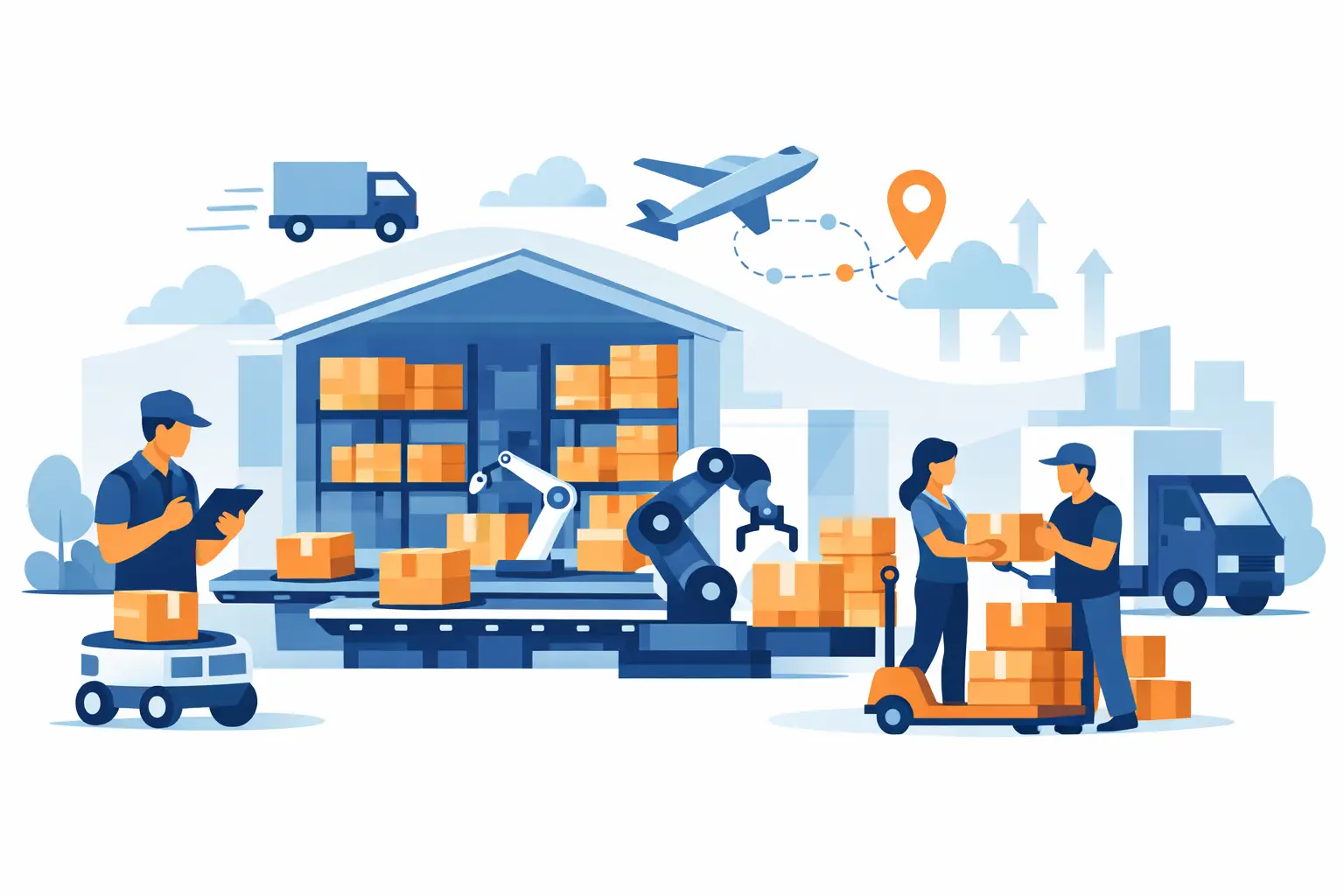
How Warehouse Fulfillment Works for Growing Orders
A customer places an order, but the delivery experience is decided long before the driver reaches the door. Inventory must be available, the correct item must be located, packed safely, labeled accurately, and handed to the right delivery network on time. That is how warehouse fulfillment works in practice: a controlled operating process that turns stored inventory into completed customer orders.
For retailers, e-commerce businesses, FMCG suppliers, and B2B distributors, fulfillment is not simply a warehouse task. It directly affects customer satisfaction, cash flow, stock accuracy, and the ability to handle peak demand without disruption.
What Warehouse Fulfillment Includes
Warehouse fulfillment covers every activity required after goods arrive at a facility and before they reach the final customer. The process typically begins with receiving inbound stock and ends with delivery confirmation or return handling.
The exact workflow depends on the business model. A B2B supplier may prepare palletized orders for scheduled commercial deliveries, while an online retailer may process hundreds of small orders with different product combinations each day. Perishable goods, regulated products, oversized cargo, and high-value items also require additional handling controls.
The objective remains the same: deliver the right product, in the right quantity and condition, to the right destination, at the required time.
How Warehouse Fulfillment Works Step by Step
1. Receiving and checking inbound goods
Fulfillment starts when inventory reaches the warehouse by air, sea, land freight, or local transport. Warehouse teams unload the shipment, compare received quantities against purchase orders or packing lists, and inspect cartons, pallets, and products for visible damage.
This step prevents downstream errors. If an inbound shipment is short, damaged, mislabeled, or mixed with another product, the issue should be recorded before inventory is made available for sale. For international shipments, customs clearance and supporting documentation may also affect when stock can move into the facility.
Once approved, goods are entered into the inventory system. Each item may be assigned a barcode, SKU, batch number, serial number, or expiry date depending on the product and the client’s operating requirements.
2. Putaway and organized storage
After receiving, products are moved into designated storage locations. This is called putaway. A warehouse management system records where each pallet, carton, or individual item is stored, allowing teams to locate it quickly when an order arrives.
Storage strategy matters. Fast-moving products are usually positioned closer to packing stations and dispatch areas. Bulk inventory may remain on pallet racking, while smaller units are replenished into pick locations. Products with expiration dates may be managed using first-expired, first-out rules, while other inventory may follow first-in, first-out rotation.
Good organization uses space efficiently, but it also protects order speed and accuracy. A crowded warehouse with unclear locations may hold enough stock, yet still struggle to fulfill orders on time.
3. Inventory control and stock visibility
Stock shown as available must match what is physically in the warehouse. Inventory control is the discipline that keeps this information reliable through system updates, cycle counts, damage reporting, stock adjustments, and replenishment activity.
For a business selling across online stores, retail locations, and wholesale channels, accurate inventory visibility helps prevent overselling. It also supports smarter purchasing decisions. Operations teams can see which products are moving quickly, which are slow-moving, and when replenishment is needed.
Real-time visibility is especially valuable during promotional periods and seasonal peaks. Without it, a business may accept orders it cannot fulfill or discover shortages only after the customer has already paid.
4. Order capture and release
When a customer places an order, the order must reach the fulfillment operation in a usable format. This can happen through an e-commerce platform integration, an enterprise resource planning system, a marketplace feed, email order file, or manual entry for B2B accounts.
The warehouse system validates essential details such as product SKUs, quantities, delivery address, payment or account status, shipping method, and any special instructions. Once approved, the order is released for picking.
Order release should be controlled, not automatic in every circumstance. A business may hold orders for fraud review, address verification, scheduled delivery dates, credit approval, or stock allocation rules. The right approach depends on the customer promise and the level of operational risk.
5. Picking the correct items
Picking is the process of retrieving products from storage for a specific order. It is one of the most labor-intensive parts of fulfillment and one of the most common sources of errors.
A picker may handle one order at a time, collect items for multiple orders in a batch, or pick full cases and pallets for commercial customers. Barcode scanning helps confirm that the selected product and quantity match the order. For high-volume operations, warehouse layouts and picking routes are designed to reduce unnecessary travel time.
Speed matters, but accuracy matters more. Sending the wrong item creates return costs, customer service work, and lost confidence. For high-value or sensitive goods, a second verification step may be justified even if it adds time.
6. Packing, quality checks, and labeling
Picked items move to a packing station, where teams verify the order, choose appropriate packaging, and prepare the shipment for transport. Packaging must protect the goods without adding unnecessary dimensional weight or material cost.
The packer may add invoices, product literature, return instructions, or branded materials based on the client’s requirements. Fragile products need cushioning, liquid products require leak prevention, and temperature-sensitive or regulated goods may require specialized packaging and documented handling procedures.
A shipping label is then generated with the recipient address, tracking number, carrier details, and routing information. Before the parcel leaves the warehouse, a final scan creates a clear chain of custody between fulfillment and delivery.
7. Dispatch and last-mile delivery
At dispatch, completed orders are sorted by route, carrier, destination, or delivery service level. The warehouse hands them to a domestic delivery fleet, courier partner, freight carrier, or customer collection point.
This handoff is where fulfillment and transportation must work as one operation. A perfectly packed order still fails the customer if it misses the scheduled linehaul, is loaded onto the wrong route, or arrives without reliable tracking information.
For businesses operating in Kuwait and across the GCC, delivery planning may involve local same-day or next-day routes, scheduled business deliveries, cross-border documentation, and coordination with air, sea, or land freight networks. The best delivery method depends on order volume, destination, product type, urgency, and cost expectations.
Returns Are Part of Fulfillment, Not an Afterthought
A return is not complete when a customer sends a parcel back. The warehouse must receive it, identify the order, inspect the product, determine whether it can be restocked, and update inventory records accurately.
Returned goods may be placed back into sellable stock, held for quality review, repaired, repackaged, disposed of, or returned to the supplier. The correct decision protects inventory value and prevents unsuitable products from being shipped again.
A clear returns process also gives commercial teams useful information. Repeated returns of a particular item may indicate a product issue, inaccurate product descriptions, poor packaging, or a recurring fulfillment error.
What Makes a Fulfillment Operation Reliable
Reliable fulfillment is built on process discipline rather than storage space alone. A warehouse needs trained staff, defined handoffs, documented exception handling, inventory controls, and systems that provide usable order and shipment visibility.
Capacity planning is equally important. A facility that works well at normal volume may struggle during major promotions, holiday demand, or large inbound shipments. Labor availability, storage capacity, packaging supplies, transport schedules, and system performance all need to be planned before peak periods begin.
Businesses should also measure performance through practical service indicators: order accuracy, on-time dispatch, inventory accuracy, damaged-order rate, return processing time, and delivery success rate. These metrics identify where delays or errors are occurring and make accountability possible.
Choosing the Right Fulfillment Model
Some businesses operate their own warehouse, which can offer direct control over staff, inventory, and customer experience. However, it also requires investment in space, systems, labor management, equipment, transport coordination, and compliance.
Outsourcing fulfillment can reduce that operational burden and provide faster access to established storage and delivery infrastructure. It is often useful for businesses entering new markets, scaling order volume, or managing variable demand. The trade-off is that the provider must offer strong reporting, clear service levels, and processes that match the business’s product and customer requirements.
For companies that need storage, domestic delivery, freight coordination, and customs support under one accountable operation, an integrated logistics provider such as K-Line can reduce handoffs between separate vendors. That can be particularly useful when inbound cargo, warehouse stock, and final delivery schedules must remain closely coordinated.
The practical question is not whether fulfillment should be in-house or outsourced. It is whether the chosen model can maintain accuracy, visibility, and delivery performance as order volumes change.
A well-run fulfillment operation gives your business room to sell with confidence. When every order can move from inventory to customer through a controlled process, growth becomes an operational plan rather than a daily risk.